Brainstorm: The 3 Levels of Growth

Like all skills in the Skills Toolbox, Brainstorm involves a path of continuous improvement and enhancement.
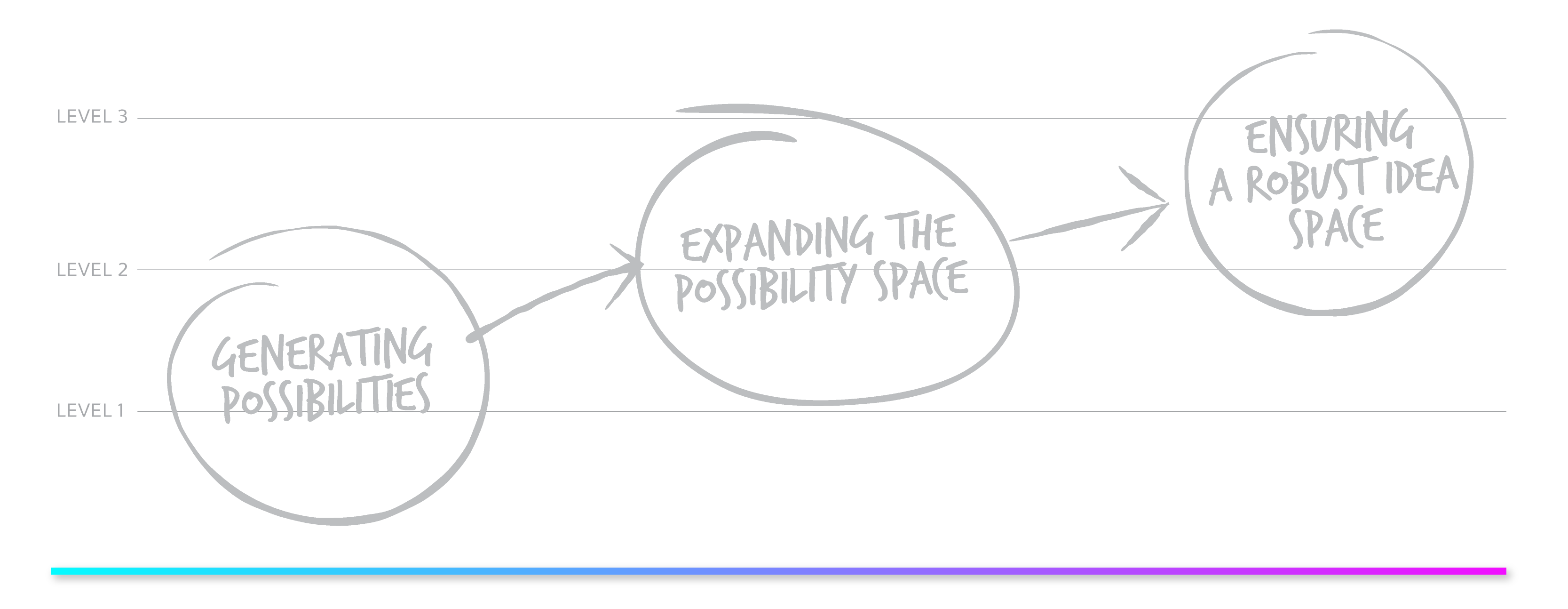
Level 1 — Generating Possibilities
Start by producing more than one idea. Most of us default to a single explanation or a single plan — not because it's the best one available, but because coming up with alternatives takes deliberate effort. Keep in mind that at this level, rough, tentative, and half-formed ideas all count! What matters is that one idea can reliably yield several more.
Keep on honing your abilities in this level until you can reliably:
- Produce more than one explanation for any situation
- Generate more than one possible action or response
- Separate idea generation from evaluation
- Get comfortable proposing tentative or incomplete ideas
- Notice when brainstorming has collapsed into a single idea
Example
Undesired approach
Deciding that a slow product launch indicates that the price point is too high, and moving straight into discount planning.
Stronger brainstorming
Listing five possible explanations spanning price, awareness, timing, positioning, and distribution before exploring any single one in greater depth.
Level 2 — Expanding the Possibility Space
Here, brainstorming becomes more deliberate and structured. You intentionally use different lenses, perspectives, and mechanisms that widen the idea space — pushing past the obvious, letting unlikely options surface, and using existing ideas as source material for new ones.
You aim to reliably:
- Generate ideas from multiple perspectives and stakeholders
- Explore several causal explanations that could account for the same outcome
- Push beyond obvious options using structured prompts
- Combine and extend ideas to produce new variations
- Notice when idea diversity is dropping — and deliberately widen the space
Example
Undesired approach
Producing eight ideas to boost sales that are all just different versions of running a promotion.
Stronger brainstorming
Producing ideas across categories, such as pricing, product mix, layout, partnerships, and service speed — then branching each into variations.
Level 3 — Ensuring a Robust Idea Space
At this level, divergent thinking holds even when everything (and everyone) pushes toward convergence. A big deadline looms, the boss clearly favors one option, and the group wants to decide ASAP— but you keep the idea space open anyway, checking for redundancies, missing categories, and unconventional possibilities before allowing evaluation to begin.
As an expert, your focus is on continually improving how to:
- Maintain diverse idea generation under time and social pressure
- Detect when multiple ideas represent the same concept
- Identify entire categories of possibilities not yet considered
- Keep unconventional explanations in play long enough to be genuinely weighed
- Recognize when the idea space is broad enough to move forward
Example
Undesired approach
Ending the session when the VP says “I think we have our answer” only ten minutes in.
Stronger brainstorming
Noting the VP's favorite, then saying “To be sure we’re weighing all possibilities, let's spend ten more minutes finding ideas that look nothing like it.”
Don't miss the next article: Six Questions to Challenge Yourself.
Or jump to any part of the Brainstorm intro series: