
The MAPPS Assessment Framework: See the Whole Situation Before You Pick a Path

An issue demanding your attention is rarely the whole situation.
MAPPS provides a structured way to consider the people, purpose, conditions, experience, and outside forces that may shape what you decide.
Why this matters
There are many assesessment tools that work in the right situation:
- SWOT Analysis
- 5 Whys
- PESTLE Analysis
- Eisenhower Matrix
- Porter's Five Forces
The beauty of the MAPPS Assessment Framework is it works in any situation. From choosing what business division to shut down at a Fortune 500 company to choosing what's for dinner tonight.
A process change may look like an efficiency question until you consider the teams and systems affected by it. A promising opportunity may look different once you examine what pursuing it would require you to give up. The immediate issue is important, but it is only one part of the assessment.
MAPPS is an easy-to-remember mnemonic that stands for:
- Moons
- Asteroids
- Your Planet
- Other Planets
- Your Sun
MAPPS is designed as a memory device. While you may not always assess a situation in the exact order of Moons, Asteroids, Planet, Planets, and Sun, the acronym provides an easy way to remember the five perspectives that make up the framework.
Fast Summary
MAPPS helps you see the whole situation before deciding what to do.
YOUR PLANET
What are you actually assessing? Clearly define the decision, problem, opportunity or situation you're trying to understand.
Optionally, go deeper to look more closely at the conditions on your Planet
- Terrain: Are you dealing with an easy or hard landscape?
- Soil: Is the ground fertile for what you are doing?
- Winds: What are the shifting trends?
- Tides: What are predictable changes?
MOONS
Who and what is connected to it? Consider the people, relationships, systems and outcomes that could be affected.
YOUR SUN
What should this assessment revolve around? Identify the purpose, principle or outcome that matters most.
OTHER PLANETS
What can you learn from similar situations? Look for relevant experience and meaningful parallels that could improve your assessment.
ASTEROIDS
What outside forces could affect it? Consider external factors — and distinguish those that could actually matter from those that are mostly distractions.
MAPPS provides a simple way to widen your perspective before taking action. Not every decision needs (or can sustain) lengthy assessment, however:
The beauty of the MAPPS framework is it can be used in as little as 15 minutes or extended out for weeks of research.
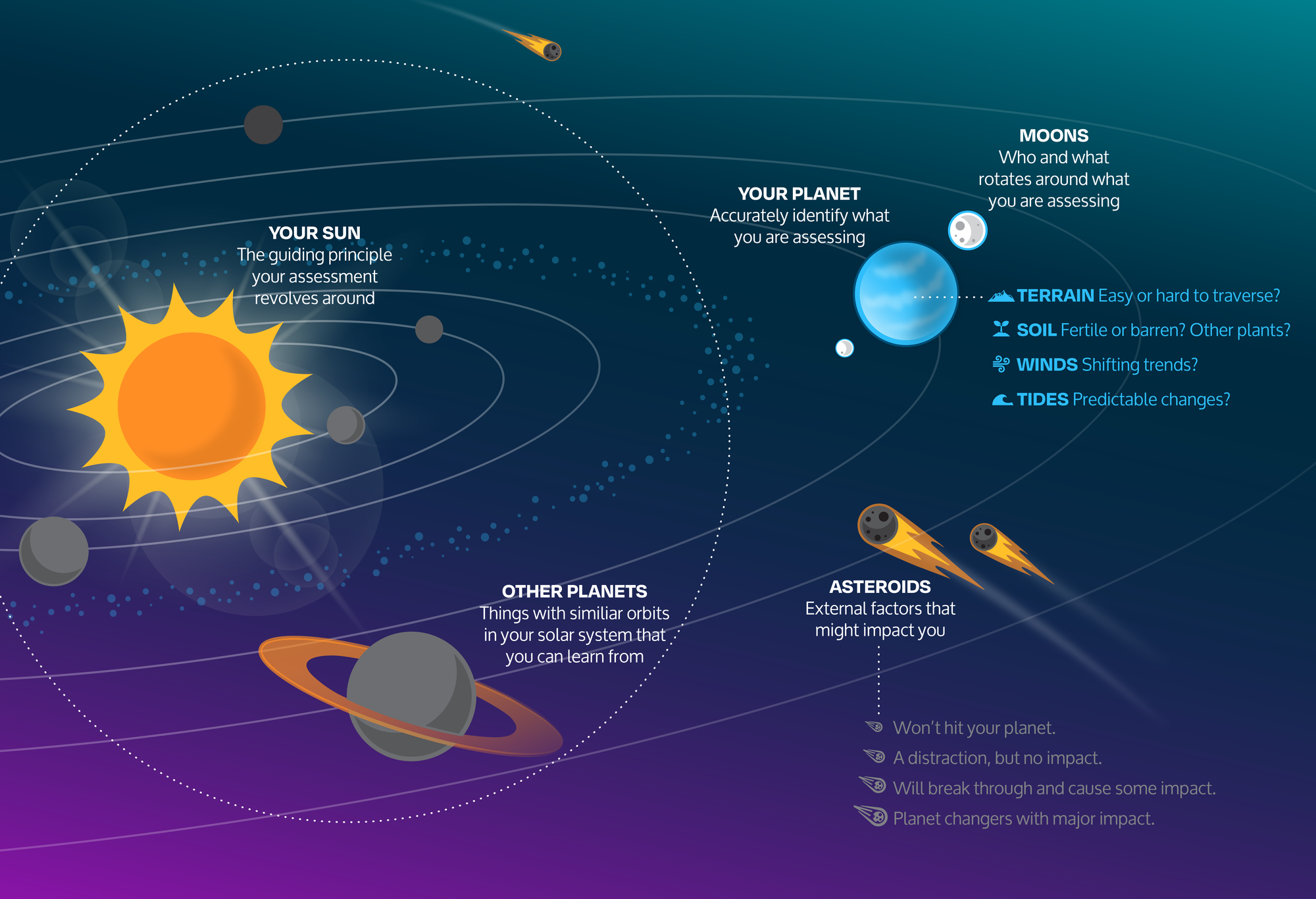
Together, the MAPPS elements create a structured way to assess a situation before deciding what to do next.
You are not simply assessing a moment. You are assessing the system surrounding that moment.
Rather than viewing a decision as an isolated event, MAPPS encourages you to view it as a planet within a larger solar system. When you do, context becomes clearer, risks become more visible, and better decisions often follow.
What It Looks Like in Practice
Imagine your company offers a service that isn't particularly profitable and relatively few customers use. Someone suggests eliminating it.
The initial assessment seems straightforward:
“We’re putting resources into something that doesn’t make much money. We should stop offering it.”
Maybe that's exactly what you should do. But MAPPS asks you to widen the view before deciding.
MAPPS At Work
Initial prompt: Your company offers a service that isn't particularly profitable and relatively few customers use. Someone suggests eliminating it.
YOUR PLANET
Is the question simply whether the service is profitable? Or are you assessing the role that service plays in the larger business?
MOONS
Which customers use the service? Does Sales use it to win larger relationships? Does it support another offering? What happens to the people currently using it?
YOUR SUN
What should the decision ultimately serve? Short-term profitability? Strategic focus? Customer retention? Long-term growth?
OTHER PLANETS
Where have you encountered something similar? What happened when you've eliminated other low-volume offerings? What can you learn from those experiences?
ASTEROIDS
Is customer demand changing? Could new technology make the service more or less valuable?
You may end up exactly where you started: eliminate the service. But now you're making that decision based on the whole situation rather than one visible fact.
The thing demanding your attention isn't necessarily the only thing that deserves your attention.
Now, let’s take a deeper look at how each element of MAPPS works.
Start With Your Planet
Your Planet is whatever you're trying to understand.
It could be a decision. A problem. An opportunity. A relationship. A project. A change you're considering. A situation that doesn't quite make sense yet.
Before assessing anything else, make sure you've accurately identified it. This sounds obvious, but it often isn't.
Stay with the service example from above. Before deciding whether to eliminate it, define the Planet carefully. You could frame the question as:
“Should we eliminate this unprofitable service?”
But that framing already assumes profitability is the main measure that matters — and that eliminating the service is the decision to evaluate.
A better Planet might be:
“What role does this service play in our business, and does that role justify continuing it?”
Now the assessment has room to reveal more. The service may be weak on its own economics but valuable because it retains important customers, supports another offering, creates a path to larger work, or serves a strategic purpose. Or the broader view may confirm that it no longer earns its place.
Before you assess a situation, make sure you're assessing the right situation.
How you define your Planet determines what you are going to look for.
Going Deeper on Your Planet
Many situations benefit from a closer look. That’s where the Terrain, Soil, Winds, and Tides of your Planet come into play:
- Terrain: How difficult is this to navigate? Is the situation relatively straightforward or unusually complex? What obstacles stand between where you are and where you are trying to go?
- Soil: What conditions already exist? Is the environment ready for what you are considering? What else is competing for attention, resources or room to grow?
- Winds: What appears to be changing? What trends, signals or shifts are beginning to emerge?
- Tides: What changes can you already anticipate? What cycles or predictable movements are already underway?
In our unprofitable service example, Terrain might include the operational difficulty of changing or winding down the service. Soil might include whether the organization is ready to replace it with something better or if the environment is just beginning to become fertile for the service.
The distinction between Winds and Tides matters. Customers beginning to ask for the service in a different way might be a Wind — an emerging signal whose direction is not yet certain. A contract renewal cycle that predictably changes demand every year might be a Tide — a change you can reasonably anticipate.
Find Your Moons
In MAPPS, a Planet never exists by itself. There are people, relationships, systems, processes and outcomes orbiting whatever you are assessing. These are your Moons.
Return to the service you're considering eliminating. If you look only at the service itself, the assessment may still seem simple: it costs more to support than it returns directly.
Now look for the Moons. Which customers rely on it? Does Sales use it to support larger relationships? Does it feed work into another offering? Which employees or processes are tied to it? What happens elsewhere if the service disappears?
You may still eliminate the service. But now you can account for what else might change when you do.
A decision rarely affects only the thing you're deciding about.
Know Your Sun
Every solar system has a center. Your Sun is the guiding principle your assessment should revolve around. It might be a purpose, a value, a desired outcome, a long-term objective or simply the thing that matters most in this particular situation.
This becomes especially important when several reasonable considerations compete for your attention.
In our service example, several reasonable priorities could compete for attention. Profitability matters. Customer retention matters. Strategic focus matters. Capacity matters. The team matters.
Your Sun asks a different question:
“What should this decision ultimately serve?”
Maybe the Sun is improving profitability. Maybe it's protecting high-value customer relationships. Maybe it's simplifying the business so the team can focus on the work with the greatest long-term potential.
Prioritization
A proper identification of your Sun can often make your decision instantly clear.
Like the sun rising over a landscape, the clearer you can see the sun → the clear you can see the path ahead of you.
The same facts can look different depending on what you're trying to accomplish.
Your Sun reminds you what the decision is supposed to serve.
Look for Other Planets
You may have never evaluated this exact service before. But you may have made a similar choice about another offering, product, client type, location or internal capability. Your competitors might have shuttered (or expanded) a similar service. There are also likely parallels in wildly different industries with wildly different products.
Those are your Other Planets: comparable situations that can provide useful experience, patterns and lessons.
- Where have I seen something similar?
- What happened?
- What worked?
- What didn’t?
- What are patterns I can learn from?
Other Planets aren't precedents you have to follow. But they can provide insights
Prioritization
At Think Slower, we often hear companies we work with say that other Planets are where they find the most meaningful guidance on how to move forward.
Not just that, but they often find the most value from other Plants that look wildly different from your Planet, but orbit around the same Sun or have similar Moons.
REAL WORLD EXAMPLE
A construction company that fabricated the materials for facades of buildings, but also built the facades using those materials for buildings in their local market. Shipped broadly, built locally.
They found incredible guidance and insights by looking at two large, regional companies in a totally different market:
- A coffee bean company that distributed nationally, but had coffee shops locally.
- A chocolate company that distributed wholesale for other food manufacturers, but also sold their own specialty chocolate bars.
This helped the construction company better understand how to speak to a broader wholesale audience, while also showing their specialty capabilities locally.
Watch for Asteroids
Not everything that could affect the service is already part of your company or customer relationships.
Competitors may change their offerings. Customer expectations may shift. New technology may make the service easier to deliver — or obsolete. Regulations or economic conditions may alter demand. These are your Asteroids.
The temptation is to pay attention to all of them. Don't.
Something happening outside your system matters only to the extent that it can meaningfully affect what your Planet. Consider four levels of Asteroids:
- Level 1: Won't hit your planet. Ignore it.
- Level 2: A distraction, but no impact. A shooting star. Ignore it.
- Level 3: Will break through and cause some impact. Understand its impact and how you’ll respond.
- Level 4: Planet-changers with extreme, life-changing impact. These are rare. Make sure it’s not actually a Level 3. If truly Level 4, know how you will survive.
Suppose a competitor announces that it is dropping a similar service. That might look like validation that you should do the same. Or it could create an opening for you. A new technology might dramatically lower the cost of providing the service. A broader market trend might sound important while having almost no effect on your customers.
But the useful question isn't simply: "Is this a big deal?" It's: "How big a deal is this for my Planet?" Sometimes the answer is: "not very."
Something can be a big deal without being a big deal for your Planet.
Try MAPPS Right Now
Choose something important enough that you're not entirely sure what to do. It could be a decision you're considering, a problem you're trying to solve, an opportunity you're evaluating or a situation you're trying to understand.
Or try this everyday example:
What should be for dinner tonight?
Your MAPPS Checklist
MY PLANET: What am I actually assessing?
Try to describe the situation without prematurely defining the answer.
MY MOONS: Who and what is connected to it?
Consider people, relationships, systems, processes and outcomes.
MY SUN: What should matter most?
What purpose, principle or outcome should your eventual decision serve?
OTHER PLANETS: Where have I encountered something meaningfully similar?
What can you learn from that?
MY ASTEROIDS: What outside forces could actually change the situation?
Separate what could meaningfully affect your Planet from what merely attracts attention.
You may reach exactly the same conclusion you would have reached before. That is fine.
The purpose of MAPPS isn't to make every decision different. And it isn't to account for every possible variable.
It's to make sure you understand enough of the situation before deciding what to do about it. Because the quality of a decision is often limited by the quality of the assessment that comes before it.
Don't just assess the moment in front of you. Assess the systems surrounding it.