Observe: The 3 Levels of Growth

Like all skills in the Skills Toolbox, Observe involves a path of continuous improvement and enhancement.
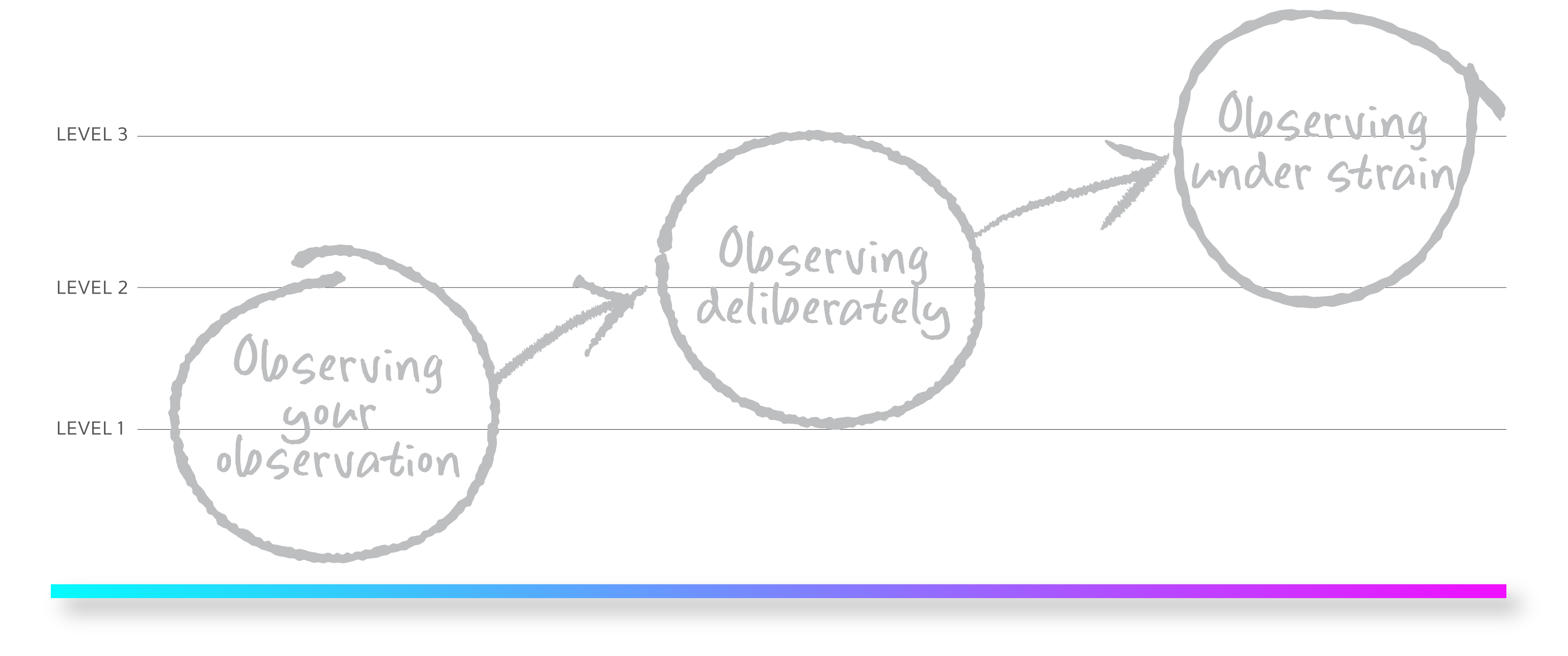
Level 1 — Auditing Your Observation Process
Start by seeking a “clean intake” of all sensory information — separating what you directly observe from any meaning you may be attaching to it. At this level, you’re actively working to prevent premature interpretation from contaminating your observations. And you’re cultivating situational awareness that will add critical context.
Keep on honing your abilities in this level until you can reliably:
- Describe what is present without inserting explanation
- Recognize the difference between observation and interpretation
- Notice how personal reactions affect perception
- Manage your attention intentionally
- Capture observations so they’re not lost or altered by memory
Example
Undesired approach
Documenting a short customer interaction solely as an observation “The employee was disengaged and the customer was unhappy.”
Stronger observation
Documenting that the interaction lasted less than 20 seconds, the employee did not make eye contact, the customer looked around twice before leaving, and no follow-up question was asked.
Level 2 — Observing Deliberately
Here, your approach becomes structured and purposeful, and observations become more methodical and reliable.
You aim to reliably:
- Capture observations systematically and deliberately
- Actively monitor personal expectations and biases
- Expand intake beyond obvious signals
- Recognize environmental and relational context
Example
Undesired approach
Only observing customer interactions during scheduled store walkthroughs with management present.
Stronger observation
Also observing customer behavior during busy periods, shift changes, understaffed hours, product returns, and interactions occurring away from leadership visibility.
Level 3 — Observing Under Strain
At this level, you can maintain peak performance of the Observe skill even in complex, fast-moving, ambiguous, or emotionally charged situations. Pressure, uncertainty, or competing stimuli are no match for your ability to observe.
As an expert, your focus is on continually improving how to:
- Maintain separation between observation and interpretation under pressure
- Monitor, and correct, internal bias in real time
- Manage attention across multiple signals
- Recognize contextual dynamics and shifts
- Reliably determine when enough observational input has been gathered
Example
Undesired approach
During a crowded industry trade show, rapidly summarizing multiple conversations into broad conclusions like “customers want simplicity” or “everyone is frustrated with the industry.”
Stronger observation
During a crowded industry trade show, stakeholders provide conflicting opinions about customer expectations, brand positioning, and market trends. Despite noise, pressure, and time constraints, you continue separating individual observations, direct customer behavior, repeated patterns, competitive messaging, and isolated opinions by using shorthand, recordings and other efficiency tools.
Check out the next article in the Observe intro series:
Six Questions to Challenge Yourself
Or skip ahead to any part of the series: