Observe: Six Questions to Challenge Yourself
Advance your skill level by purposefully challenging yourself and taking stock of your own approach to observation.
As you seek to grow this skill within your Toolbox, use these questions in the real world:
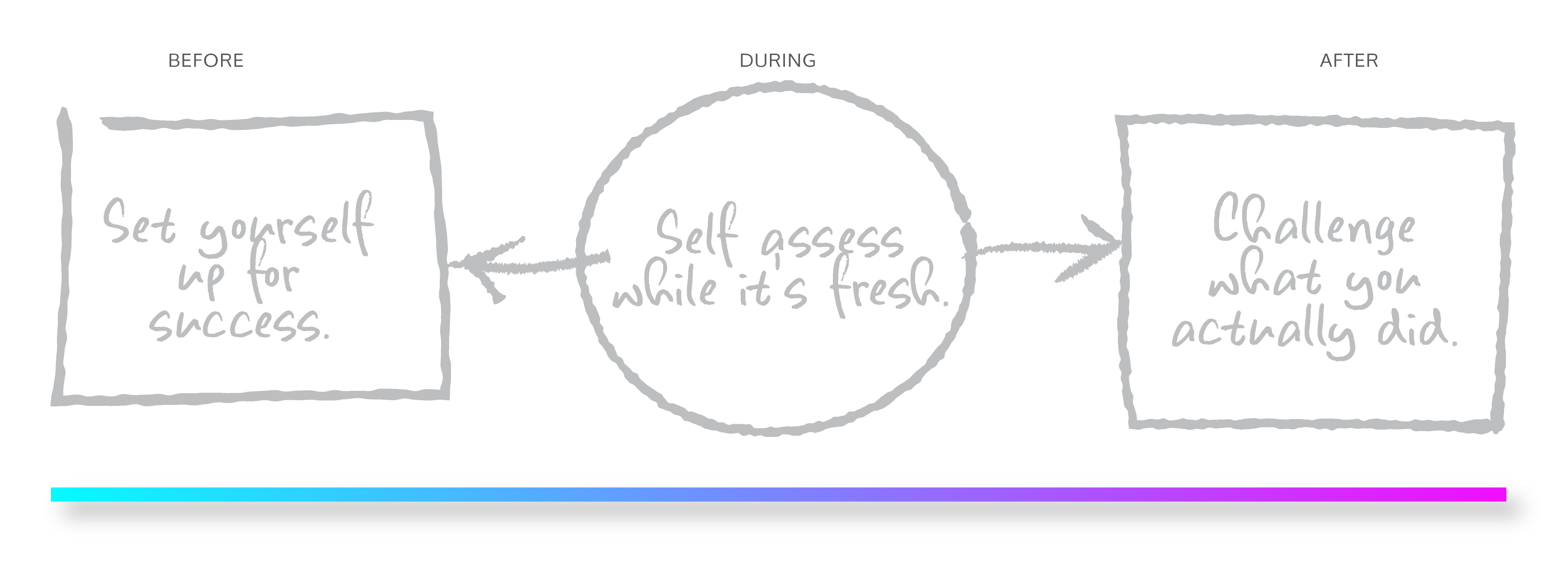
- Before: Review prior to observing to help you stay on the right path.
- During: Stop partway through your Observe session to self-assess.
- After: Challenge your approach to gather learnings for the next time you Observe.
What did my senses actually register?
Protect the integrity of any incoming information.
Many people skip directly to interpreting what they Observe without actually capturing their observation. This question starts the active process of separating observation from analysis.
Example
Undesired approach
Describing a store visit as "customers seemed confused and employees were overwhelmed."
Stronger observation
Documenting that four customers asked where to find the same product within 15 minutes, two employees stopped stocking shelves to answer questions, and the checkout line extended into the main aisle twice during the observation period.
How might I be distorting what I observed?
Manage your influence on observations.
A subtle flip side to the first question, (which prompts you to train your objectivity). Here, you are challenging your ever-present biases and assumptions.
Example
Undesired approach
Assuming a location's employees are unmotivated because they appear less energetic than their counterparts at higher-performing stores.
Stronger observation
Separating personal interpretation from observation by documenting staffing levels, customer volume, employee task-switching frequency, aisle bottlenecks, response times, and direct customer interactions before drawing conclusions.
Where should my observation be directed right now?
Direct your attention to the right place.
Every observation is a choice. Some observations you only get one opportunity to capture. Others you can revisit. Some have complexity that necessitate going deep and wide, while others are fairly one-dimensional.
Example
Undesired approach
Focusing almost entirely on customer complaints and visible service failures during store visits.
Stronger observation
Also observing successful customer interactions, employee workarounds, store flow, transition moments, environmental conditions, and how customers behave when they do not ask for help or provide negative feedback.
How do I preserve what I observed so it remains accurate?
Protect your observational data over time.
Yes, you want to guard against forgetfulness, but it’s also important to prevent any memory distortion and reinterpretation. Not all observations will fit the same rubric, so you’ll want to tailor your recording to preserve the original data, sequence, and feel of what actually happened.
Example
Undesired approach
Waiting until the end of the day to summarize multiple store visits from memory into general impressions.
Stronger observation
Capturing timestamped notes, direct customer quotes, environmental conditions, interaction sequences, and immediate observations after each location visit throughout the day before your memory begins compressing or reconstructing details.
What surrounding conditions shape what I’m observing?
Frame observations within their broader environment.
Look at something in isolation, and you miss critical clues found when taking in its surrounding landscape. Observing the full context involves an awareness of how the environment, relationships, timing, sequence, and other surrounding conditions influence what you see.
Example
Undesired approach
Documenting a chaotic internal meeting as evidence that the management team is disorganized and ineffective.
Stronger observation
Noting that the CEO was attending the meeting for the first time, leadership announced beforehand that management performance would be observed as part of the research effort, several attendees were called on unexpectedly, and discussion patterns shifted noticeably once the CEO entered the room.
Do I have enough reliable observations yet?
Protect the Observe stage before moving on.
This might feel like an art, but you can actually rely on science to answer. The science examines the variety and volume to see how much relevant information remains while factoring in how much repetition you're seeing. A good fallback: keep asking Who?, What?, Where?, When?, Why?, and How? to uncover the variety and volume of what you’re observing.
Example
Undesired approach
Reaching a conclusion after reviewing several customer complaints and observing only a few store locations.
Stronger observation
Continuing observation across customer interviews, employee shadowing, internal planning meetings, prior research, trade show discussions, and multiple locations until patterns consistently emerge across different environments and stakeholder groups.
Check out the next article in the Observe intro series:
Failure Modes to Look Out For With Observe
Or skip ahead to any part of the series: